
Industry -Introduction to Automation & Project Skills
If Lesson 4.1 was about reading the machine’s instructions, this lesson is about understanding the machine’s brain—the automation system—and the human processes used to manage it. No matter how advanced your tools or how accurate your schematics, the entire system relies on a control program to tell it when to act and what quality standards to meet. In the workplace, this means you must master not just the control logic (PLCs), but also the project skills (management, quality, scope) that ensure your work is completed efficiently and correctly.
Automation Control Systems (The Brain)
The foundation of modern industrial automation is the Programmable Logic Controller (PLC). This is a rugged, specialized computer designed to operate reliably in harsh industrial environments.
- The Control Loop:
- The PLC executes its program in a continuous, cyclical process called the Control Loop. This loop includes:
- Input Scan: The PLC checks the status of all physical inputs (buttons, sensors, limit switches) and records their state (ON/OFF) in its memory.
- Program Execution: The PLC executes the ladder logic program line by line (rung by rung), using the stored input values to determine what outputs should be activated.
- Output Scan: The PLC updates the physical outputs (solenoids, motor starters, lights) based on the results of the program execution.
- I/O (Inputs and Outputs)
- Inputs (I): Signals coming into the PLC from the machine (e.g., “The box has arrived,” “The start button is pressed”).
- Outputs (Q): Signals going out of the PLC to control the machine (e.g., “Activate the motor,” “Open the valve”).
- The PLC executes its program in a continuous, cyclical process called the Control Loop. This loop includes:
Introduction to Programming Logic
Control systems use simple logic to create complex automated sequences. You will primarily encounter two types of logic flow:
- Sequential Logic (The “Order”)
- This is a step-by-step process that executes actions in a strict, fixed order. The system cannot move to Step B until Step A is complete.
- Example: “Step 1: Extend Cylinder.” $\to$
“Step 2: Wait 5 seconds.” $\to$ “Step 3: Retract Cylinder.”
- Example: “Step 1: Extend Cylinder.” $\to$
- This is a step-by-step process that executes actions in a strict, fixed order. The system cannot move to Step B until Step A is complete.
- Conditional Logic (The “If/Then”)
- This is decision-making logic that executes based on the state of an input. It often involves Boolean checks (True/False).
- Example: IF the Safety Guard is closed AND the Part is in place, THEN allow the cycle to start
- This is decision-making logic that executes based on the state of an input. It often involves Boolean checks (True/False).
A typical industrial process is a combination of both: Sequential steps are executed only after Conditional safety and readiness checks pass.
Project Management and Quality
As a technician, you are not just repairing; you are often part of modification, installation, or upgrade projects. Understanding basic project management and quality control (QC) ensures you are a valuable and efficient team member.
- Project Scope
- The documented list of specific goals, deliverables, features, and tasks required to complete a project.
Why it Matters: Clearly defining the scope prevents Scope Creep—the uncontrolled expansion of the project by adding new, unplanned features. Scope Creep wastes time, budget, and resources.
- Quality Control (QC)
- Quality control is a set of processes to ensure the final product (whether it’s a repaired machine or a newly installed system) meets predefined standards. This involves systematic inspection and verification.
The Role of the Mechatronics Technician
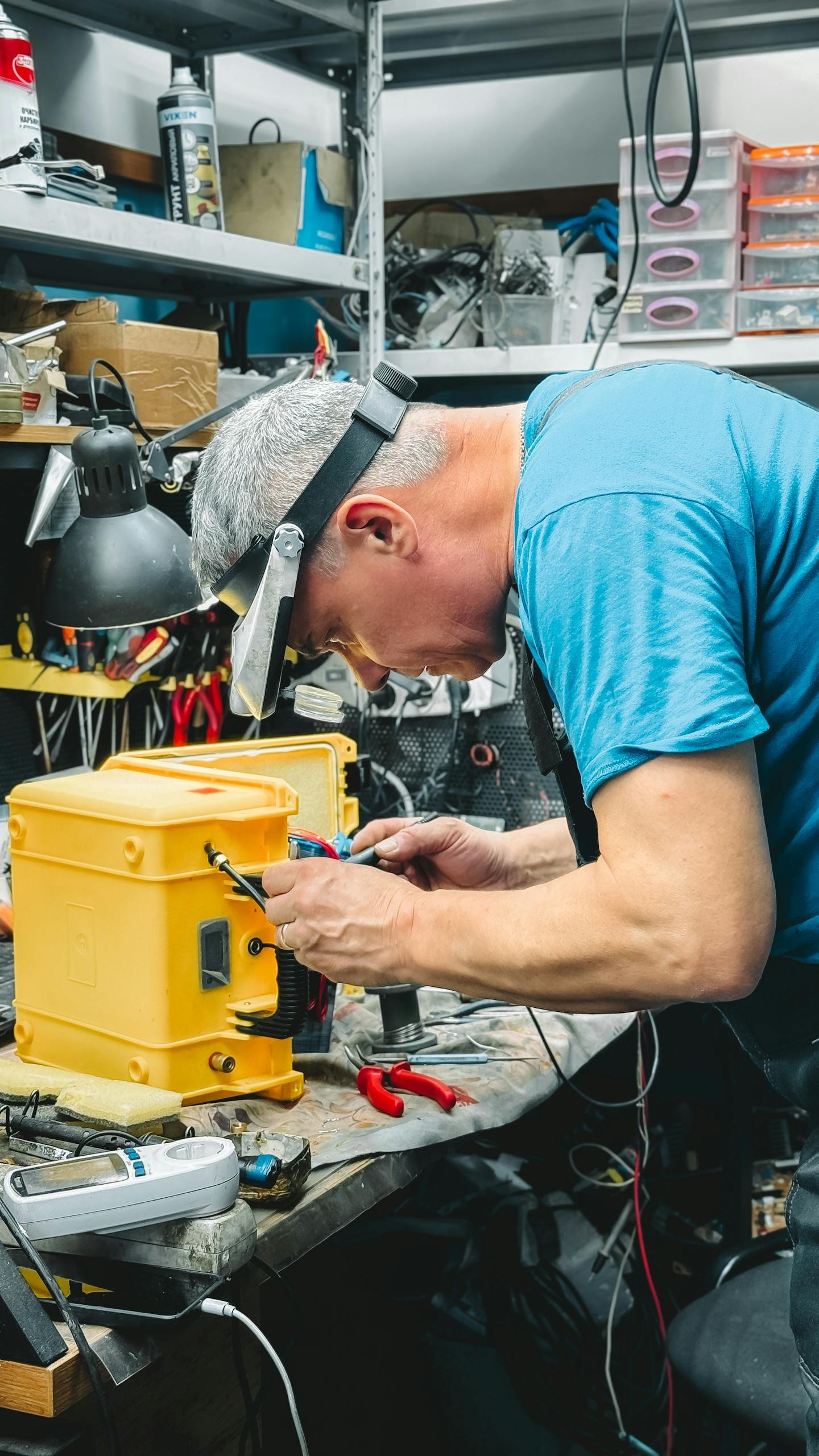
Your hybrid skills make you valuable across several key project phases:
- Installer/Builder: Following mechanical drawings and electrical schematics to assemble and wire machine components according to specifications.
- Troubleshooter/Diagnostician: Using schematics and DMMs to identify and correct faults based on the machine’s control logic.
- Quality Assurance / Control (QA/QC): Performing functional tests and calibrations after repairs or installations to ensure performance metrics (speed, torque, accuracy) are met before the machine is returned to production.
The PDCA Cycle for Maintenance and Quality
The Plan-Do-Check-Act (PDCA) cycle is a four-step model for carrying out continuous improvement. It is a fundamental quality control process used to solve problems systematically and prevent recurrence.
- Plan: Identify the problem, analyze the root cause, and develop a solution (e.g., Plan to replace a faulty sensor and recalibrate).
- Do: Implement the solution on a small scale or in a controlled environment (e.g., Install the new sensor).
- Check: Measure the results against the original goal. Did the repair fix the problem? Is the system working within tolerance? (e.g., Check the sensor’s output with the DMM).
- Act: If successful, standardize the process.
- If not, go back to the Plan stage and try a different solution (e.g., Document the successful repair and return the machine to production)..
The Importance of Redundancy and Interlocks
As a technician, you must recognize that control systems are often designed with redundancy (backup systems) and interlocks (safety features that prevent one action from occurring unless a preceding action is complete).
When troubleshooting, always check the interlocks first. A failure is often not the device itself, but a condition (like a pressure being too low or a door being open) that is preventing the control system from sending the “go” signal.
Practical Applications
Understanding automation and project skills means you are moving from being a mechanic or an electrician to an integrated systems technician. You are the person who can read the logic, fix the wire, and ensure the entire process meets quality standards and project deadlines.